
How to
Troubleshooting Connect
On this page
This page helps you fix problems with Connect connections. An internal connection stays inside one organization. An external connection reaches a partner or a customer. Most connections and syncs work right away. Each section below names a symptom, its likely causes, and what an admin or an end user can do about it.
Before you start, note which connection is affected and which direction fails, Slack to Teams or Teams to Slack. Also pick one message or action that failed. These details point you to the cause, and support needs them if you escalate.
Useful references
- Integration account (Microsoft Teams)
- Working in connected channels (mentions, reactions)
- File and image sharing settings
- Message headers and thread syncing
Before you troubleshoot
User sign-in (no admin required)
Each user signs in by clicking Sign in with Slack, Sign in with Microsoft, or both. This step needs no admin. Every user should do it.
Signing in doesn’t install Conclude in a workspace. Conclude can only find and sync channels after an admin has added it, as described below.
Admin setup (admin required)
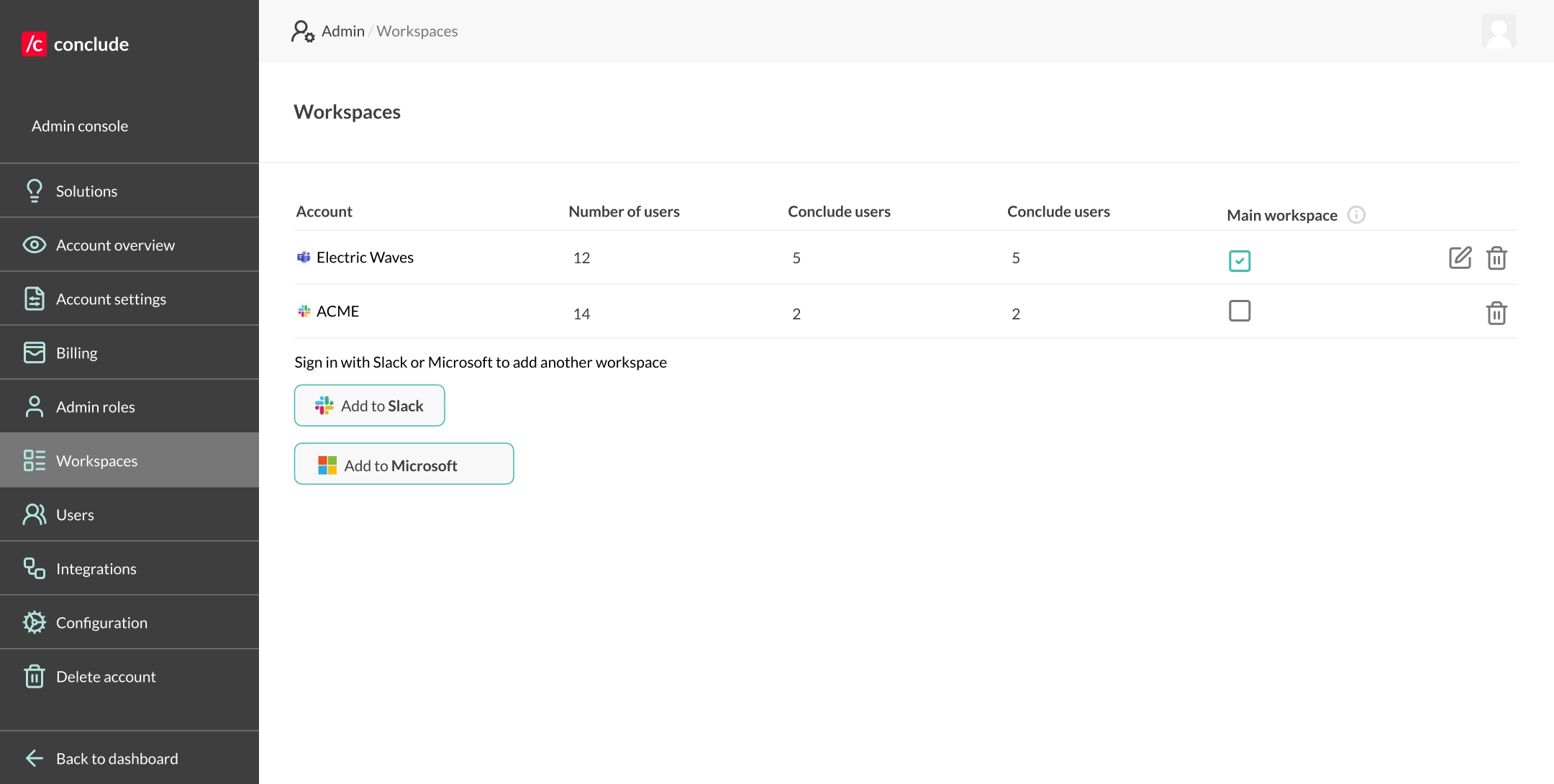
A Slack workspace admin or a Microsoft Teams tenant admin has to add Conclude and approve its permissions. Without that, Conclude cannot find channels and chats, and it cannot sync content, files and mentions. Only an admin can approve some of these scopes. Conclude requests them from Admin console > Organization > Workspaces > Add to Slack / Add to Microsoft .
Platform account requirements
- Slack: Conclude works with free Slack workspaces
- Microsoft Teams: Conclude needs a paid Microsoft 365 or Teams plan. You cannot install Conclude on free Teams. A free tenant usually doesn’t support third-party app installation or tenant admin consent for Microsoft Graph permissions. Conclude needs both to reach and sync Teams channels and chats
Symptoms and fixes
Jump to a section:
- No channels or chats appear when you set up a connection
- You cannot find one specific channel or chat
- A person is missing from a member picker
- Messages arrive late or not at all
- Messages in Teams come from the wrong sender
- Replies or threads look different
- Files and images don’t arrive as you expect
- @mentions or reactions are unreliable
- Microsoft Teams integration account
- Duplicate user accounts
- A guest user cannot create connections
- What to send to Conclude support
No channels or chats appear when you set up a connection
Likely causes
- Permissions are not granted. The Slack or Teams admin has not finished the authentication
- Missing access. You are not a member of the channel or chat, or it is private or restricted
- Missing Conclude permission. The person setting up the connection doesn’t have the Conclude permission for that connection type
- Guest user limits. This is common in external connections
- Another company hosts the Teams shared channel. Conclude cannot connect a shared channel that another company hosts and shares with your team. Microsoft does not let apps outside the hosting company see the channel’s members or get its message notifications. A chat that another company hosts can be connected
What to do (admin)
- Check that the permissions are granted
- Check the user’s access
- Make sure the user is a member of the Slack channel and of the Teams channel or chat
- Make sure the channel or chat is not private or restricted without the right members added
- Check the user’s Conclude permission
- Go to Admin console > Users and access > Roles & permissions
- Check that the user has Connect channels for internal connections, or Connect external channels for external ones. See Roles and permissions
- Check who owns the channel
- Make sure the user is not trying to create or manage a connection for a channel that another organization owns. That happens with guests and with shared channels
You cannot find one specific channel or chat
Likely causes
- You are not a member, or the channel is private or restricted
- The channel is a Teams shared channel that another company hosts
- You are a guest in the workspace or tenant that holds the channel
- The channel or chat is new. New channels can take some time to appear in Conclude
- A duplicate user identity. See Duplicate user accounts below
What to do
- Check the workspace, the team and the exact name of the channel or chat
- Check that you are a member of the channel you are trying to connect. For a private channel, you need to be a member of the channel itself
- Check that the channel is not a Teams shared channel that another company hosts. Conclude cannot connect those
- Check that you are a full member of the workspace or tenant, not a guest
- Refresh Conclude, or sign out and sign back in
- If it still doesn’t show, ask your admin to check for duplicate accounts. See Duplicate user accounts further down
A person is missing from a member picker
What you see
You start a chat or pick members, and someone who exists in Slack or Teams doesn’t appear.
Likely causes
- The account is hidden. Conclude leaves a hidden account out of the user directory, search results and user pickers
- The email domain is filtered out. An account admin can limit the email domains Conclude shows. Users from other domains don’t appear in the directory, in search or in user pickers. That includes the picker for
/c chat - The person is new. New users can take some time to appear in Conclude
- A duplicate user identity. See Duplicate user accounts
What to do (admin)
- Go to Admin console > Users and access > Users and change the account filter to Hidden accounts. If the person is there and should be visible, unhide the account. See Hide user accounts
- If your account filters email domains, the filter menu on the same page has an Outside your domains view. Check whether the person is listed there. See Manage email domains
Messages arrive late or not at all
Likely causes
- You are posting in the wrong channel or chat, one with a similar name
- Slack or Teams delayed the event. Platform events can lag now and then
- The thread sync settings are not what you expect. This shows up most with older threads
- The message comes from a bot or an app, or it is a Teams system message. Those don’t sync unless the connection is set up to sync them
What to do
Confirm you are posting in the connected channel or chat.
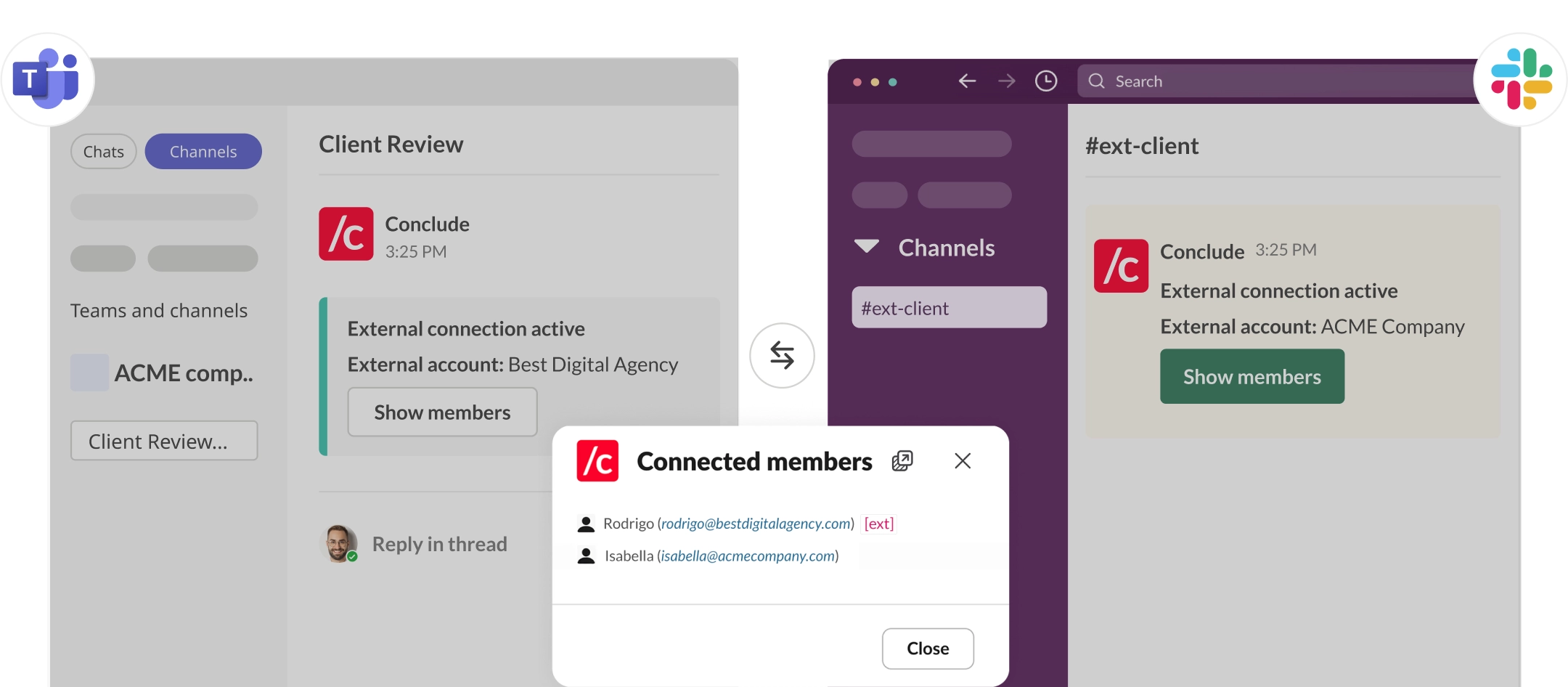
- Conclude pins a message in the connected channel. It says Connection active for an internal connection and External connection active for an external one. The message shows which channel or chat it is connected to
- Click Show members to check who is included on both sides
- Send a new message in that channel or chat, and check that it arrives. Then test the other direction
If you are replying inside an old thread:
- A thread that existed before the connection follows your organization’s thread syncing settings
- If your reply shows a note that syncing is unavailable, the connection is set not to sync replies on existing threads
- Ask your admin whether syncing is enabled for existing threads. See Existing threads
If a message from a bot or an app is missing, or a Teams call notice:
- Ask your admin to check the System and bot messages tab in the connection settings. See System and bot messages
If the problem continues, escalate to support. Email support@conclude.io with:
- Channel or chat names on both sides
- Links to the affected messages, if you have them
- Exact timestamps, including the timezone
- Which direction is failing, Slack to Teams or Teams to Slack
Messages in Teams come from the wrong sender
What you see
In Microsoft Teams, some synced messages look like another user posted them. The real sender’s name may still appear in the message text.
Why it happens
Conclude cannot post as the real Teams user when that user’s Teams credentials are missing or not authorized. Conclude then posts under a fallback identity.
How to fix (admin)
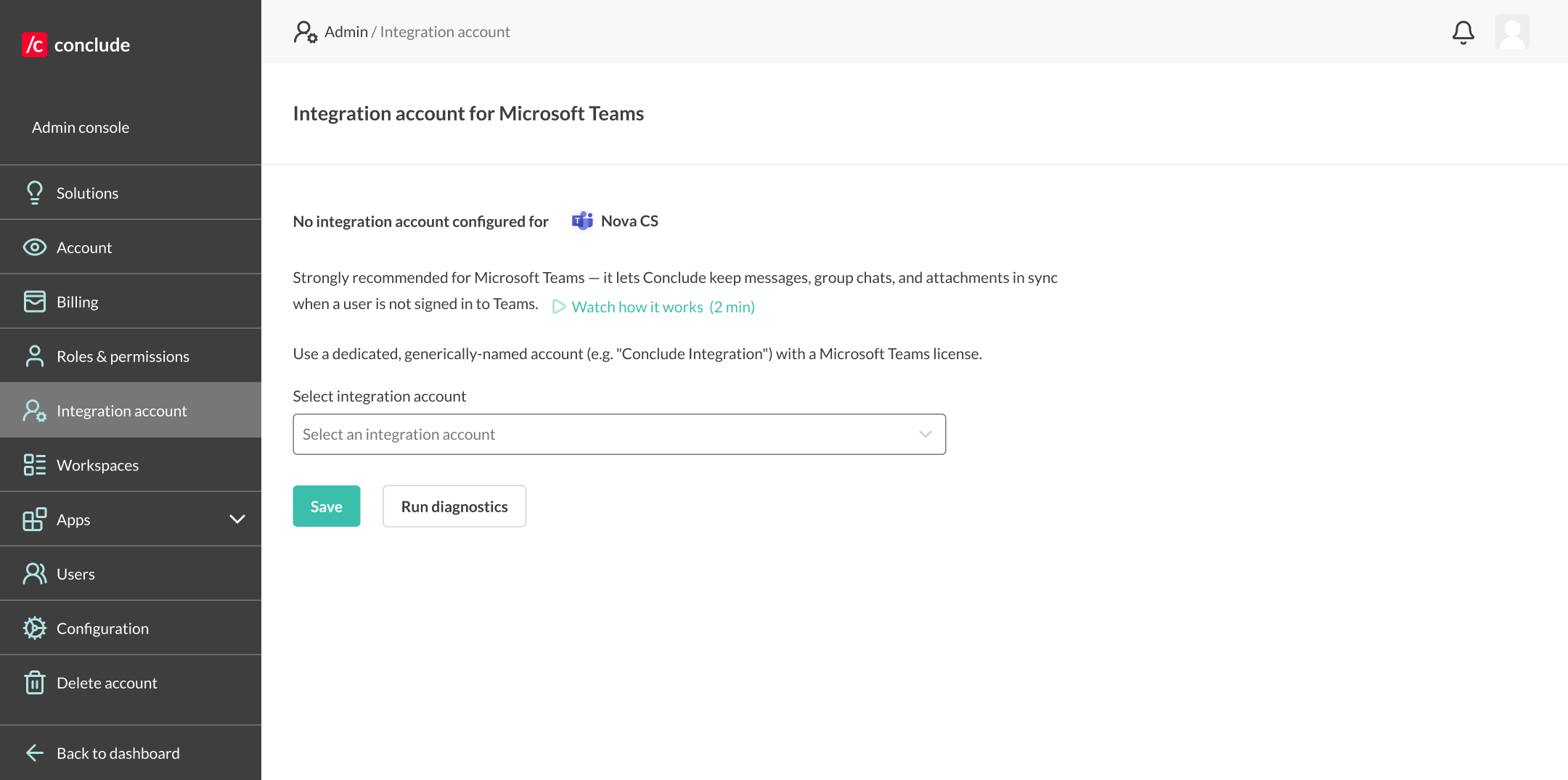
- Set up a Microsoft Teams integration account in Conclude. See the section below
- Add the integration account to the team and to each channel or chat where messages sync. A private channel needs direct membership. Repair on the integration account page adds the account to connected channels and chats where it is missing
- Check that the integration account has a valid Microsoft 365 license that includes Teams
- Send a new message to test it. Check which account posted it in Teams, and that the header names the original sender
Replies or threads look different
This is normal.
Why it happens
Slack and Teams structure their threads differently. Admins also decide how Conclude handles threads that existed before Conclude was installed or connected.
What to do
- If context matters, quote the message you are replying to, or add a short reference
- Admins can adjust the thread syncing behavior:
- Internal connections: the default is to sync full threads
- External connections and Bridge: the default is to sync part of the thread, which is the first message plus new replies
- An admin can also turn off syncing of replies on existing threads. See Existing threads
Files and images don’t arrive as you expect
Likely causes
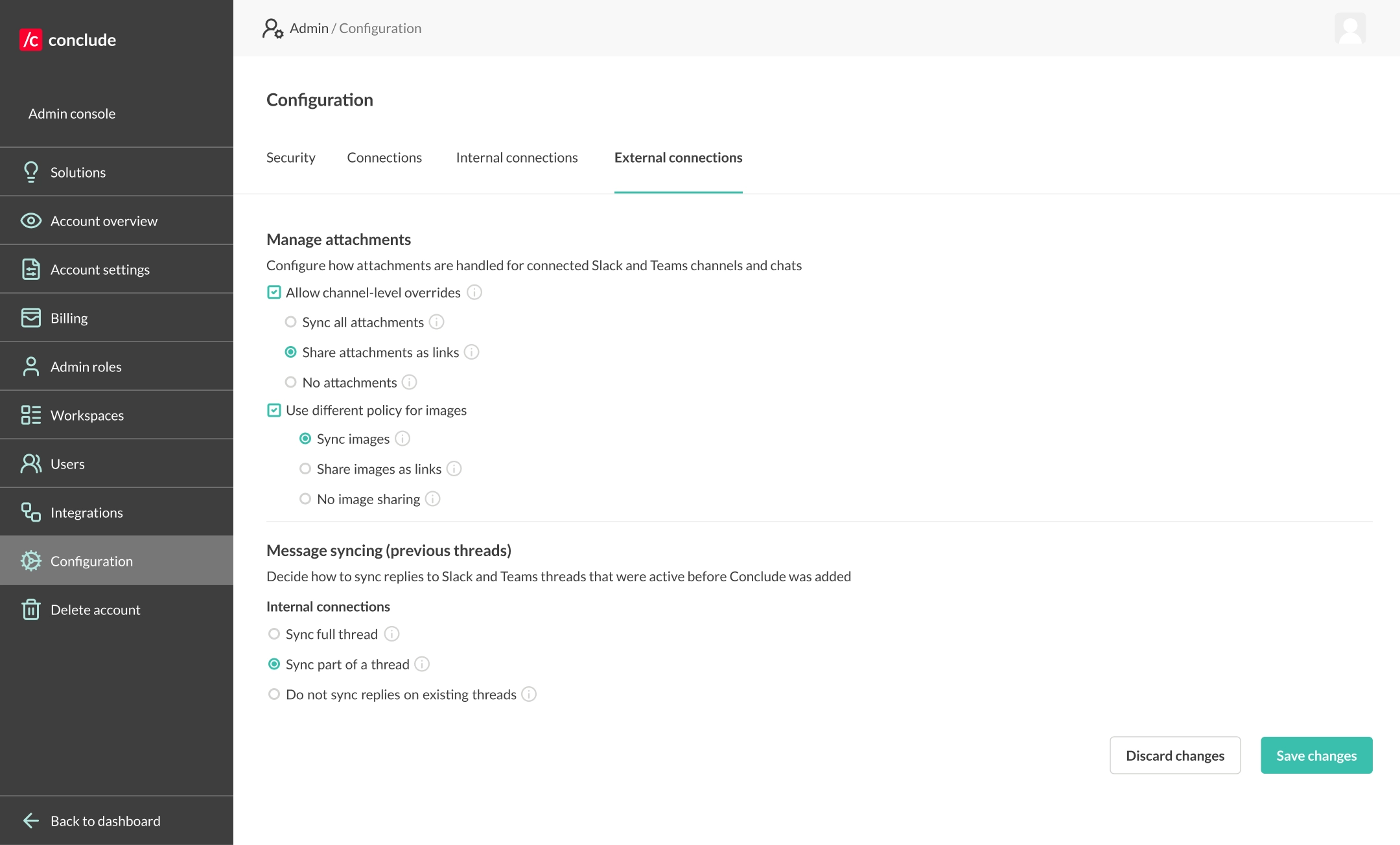
The attachment policy for the connection decides what happens to an attachment. There are three policies.
- Sync all attachments requires the Microsoft permission
Files.ReadWrite.All - Share attachments as links means the recipient needs access to the platform the file came from
- No attachments leaves attachments out
Images can have their own policy: Sync images, Share images as links or No image sharing. A single connection can also use its own policy, if an admin allows overrides. On an external connection, each company sets the policy for its own side, and a message follows the policy of the company that sent it. See File and image sharing.
| What you see | What to check |
|---|---|
| A file or image arrives as a link | Share attachments as links or Share images as links is selected. The recipient needs access to the original file. |
| The text arrives without the file or image | No attachments or No image sharing is selected. Conclude adds a note that it left out an attachment. |
| A file meant for Teams arrives as a link with a note | Conclude could not copy the file into Teams. Check that Files.ReadWrite.All is granted, and ask the user to sign in again. Also check the integration account’s sign-in and channel membership. |
| Internal and external connections behave differently | They have separate tabs and defaults under Sync settings. Each side of an external connection can also set its own policy. |
What to do (end user)
- Ask your admin which attachment policy this connection uses
- If you get links that you cannot open, you most likely don’t have access to the platform the file came from. That is expected behavior
What to do (admin)
- Review the global settings in Manage attachments under Admin console > Connect > Sync settings . Also review the per-connection overrides if Allow channel-level overrides is on. Internal connections, external connections and Bridge have separate tabs
- If you want full file and image sync:
- Grant
Files.ReadWrite.All - Enable Sync all attachments and Sync images
- Grant
@mentions or reactions are unreliable
Mentions to people outside your organization
Autocomplete in Slack and Teams only knows the people who exist natively in your workspace or tenant. It cannot find someone from another organization. See Mentions.
Mentions inside your organization
A mention across channels works when the person is signed in to Conclude and has credentials linked on both platforms. Without credentials on both platforms, the @name does not autocomplete. The person still receives the mention if you use the correct handle.
What to do
- Encourage users to sign in to Conclude with the right Slack or Microsoft account. This helps the most
- Type the first and last name together, without a space. Type
@EmmaGreeninstead of@Emma Green - If Slack or Teams still tries to autocomplete, press Escape after the first name to close the suggestion. Then keep typing the last name without a space
- Mentions can stay unreliable on external connections, for example when a bot or a fallback identity posts them. This affects mentions from Slack to Teams the most. Enable a Microsoft Teams integration account
Emoji reactions
Some emoji differ between Slack and Teams, and that is expected. Use the more common emojis if reactions must be visible on both sides.
Who can post a reaction on the other side also matters:
- When the person who reacted in Teams has no Slack account, the Conclude bot posts the reaction in Slack. Slack then shows each emoji once, however many people reacted
- When Conclude posts reactions in Teams through the integration account, Teams only shows the most recent reaction
- When neither the Conclude bot nor the integration account can post in Teams, a reaction from Slack doesn’t sync
See Reactions.
Microsoft Teams integration account
When you should use it
Use an integration account for external connections, and whenever not everyone has credentials on both platforms. We strongly recommend it there. It makes two things more reliable:
- Posting messages
- @mentions, especially from Slack to Teams
It also fixes messages in Teams that seem to come from a fallback or random sender. Those appear when the real user’s credentials are not available. See Integration account.
Common issue: the integration account is not working
Likely causes:
- The integration account doesn’t have a proper Microsoft 365 license that includes Teams. Teams Free, Entra-only and unlicensed shared mailbox accounts do not work
- The account is not signed in or authorized inside the Conclude admin settings
- The integration account is not added to the relevant team, or to the private channels and chats where it needs to post
Read more about how to assign Teams add-on licenses to users.
What to do (admin)
The integration account must be a member of the team and the connected channel. It also needs membership in any private channel or chat where you expect it to post.
- Create a generic Teams user that is not tied to a real employee identity
- Assign a valid Microsoft 365 license that includes Teams
- Open Admin console > Organization > Integration account . The page only appears when the organization has a Microsoft Teams workspace
- Select the integration account you created from the drop-down, then click Save
- Click Run diagnostics. It checks that the account exists in the directory and is signed in to Conclude. It also checks that the account has Microsoft Graph access and a Teams license. Finally, it checks that the account is a member of every team and connected channel or chat that needs it
- If the account is missing from connected channels or chats, click Repair. Conclude adds the account to each one, using the credentials of a channel member who is signed in to Conclude
- If you just added the account to the tenant, reload the Admin console. You can also sign out of Conclude and back in
- Add the integration account to the teams that contain connected channels. Repair cannot add it to a team, so a team owner does that in Teams
- Repair also cannot add the account to a shared channel that another Microsoft 365 tenant hosts. An owner of that channel adds it in Teams
Duplicate user accounts
What you see
- When creating connections, you can see channels in Slack but not in Teams, or the other way round
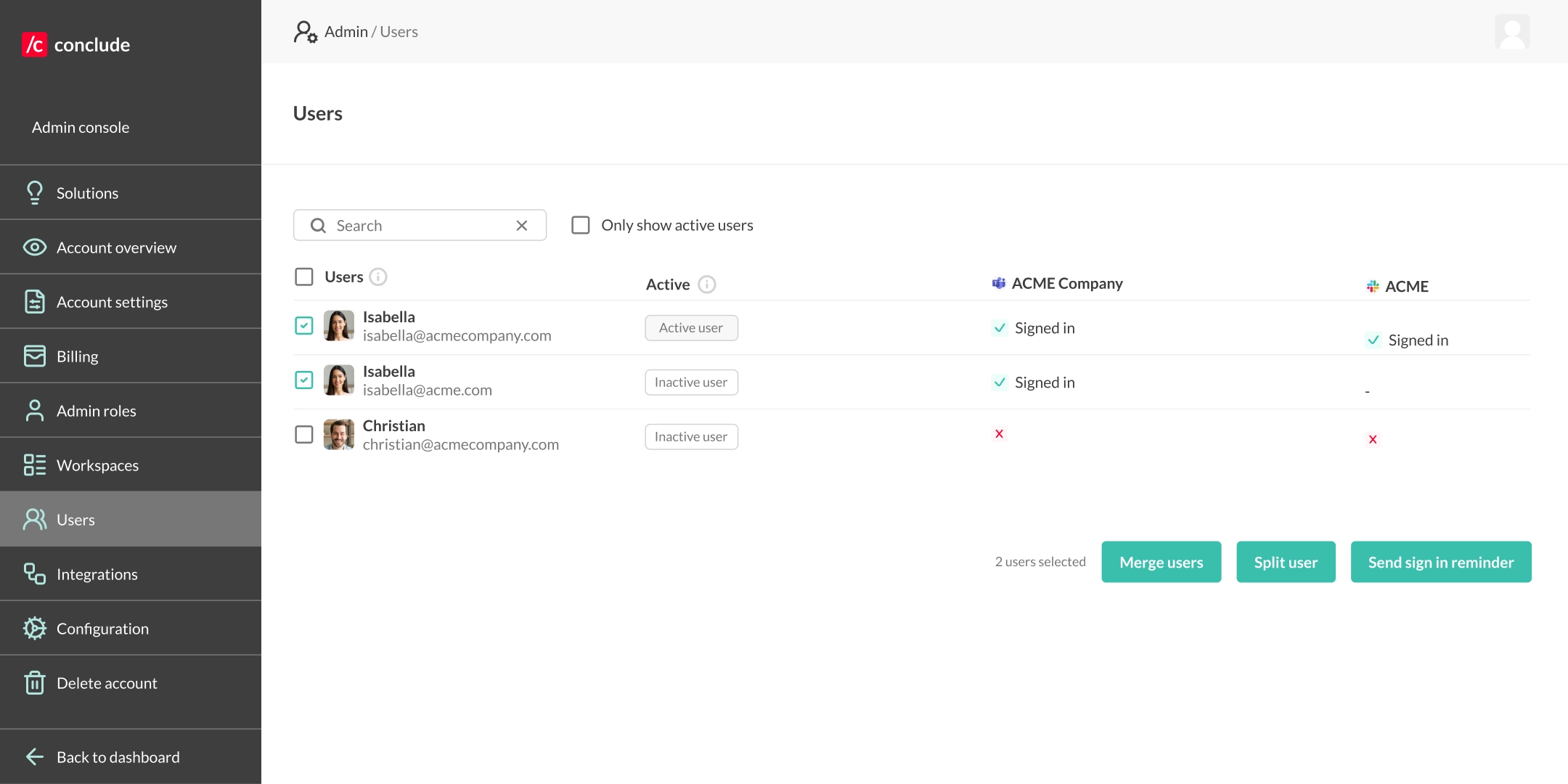
- The same person appears twice under Admin console > Users and access > Users
Why it happens
Conclude matches Slack and Teams accounts that use the same email address on its own. Some users have different email domains in Slack and Teams, or several email addresses. Conclude may not merge them automatically. That affects what they can see and the features that depend on identity.
Fix (admin)
Go to Admin console > Users and access > Users . Select the two accounts and click Merge users. You can also open the more (…) menu and choose Merge duplicate accounts. The person then has one unified profile. See Merge user accounts.
Merging only works for accounts that don’t share a workspace. Usually one account is in Slack and the other in Teams. If both accounts are in the same workspace, Conclude refuses the merge. Hide the unwanted account instead. See Hide user accounts.
A guest user cannot create connections
What you see
A guest user can take part in synced channels. The same user cannot create or manage connections.
Why it happens
The platforms restrict guests. A guest cannot create or manage connections for channels or chats outside their own Slack workspace or Teams tenant.
How to fix it
Ask a non-guest user, a full member of that workspace or tenant, to set up or manage the connection. That person also needs the Conclude permission for the connection type.
What to send to Conclude support
When escalating to support@conclude.io, include:
- Connection type, internal, external or Bridge
- Workspace or tenant names, or the organization name in Conclude
- Channel or chat names on both sides
- Links to the affected messages, if you have them
- Exact timestamps, including the timezone
- Direction of failure, Slack to Teams or Teams to Slack
- The thread syncing or attachment policy, if the problem is about threads or files
- Whether an integration account is configured and licensed, and the result of Run diagnostics
Most problems on this page go away after a short admin check. Support is on hand for anything that doesn’t.