Securing Enterprise Communications Across Slack and Microsoft Teams
 Conclude Team
 Sian Bennett
According to Gartner research, 75% of enterprise businesses rely on two or more chat platforms, yet fewer than 40% can effectively audit or manage cross-platform data. This fragmentation creates enterprise communication security and compliance risks that IT and Security teams often underestimate.
When departments operate in both Slack and Microsoft Teams, the challenge goes beyond simple connection. It becomes a question of maintaining visibility, enforcing policy, and staying audit-ready across disconnected platforms. For IT leaders and security professionals, this fragmentation poses real risks: audit trails don’t align, retention policies are unevenly applied, and communication oversight develops blind spots.
This article explores how large enterprises can maintain security and compliance when Slack and Microsoft Teams coexist. You won’t need to consolidate platforms, expand guest access, or create unmanaged workarounds to achieve this. You’ll discover why traditional solutions fall short and learn what compliance teams are up against. You’ll also understand how a secure cross-platform communication layer helps organizations maintain complete visibility and control – all within their existing governance frameworks.
The Enterprise Security Challenge: Why Multiple Platforms Create Risk
For most large enterprises, having some teams on Slack and others on Microsoft Teams is a reality. Whether it’s due to a merger or different teams preferring different tools, organizations often have to manage multi-platform compliance.
While this flexibility helps teams work, it creates a governance headache. When communication happens across disconnected platforms, security leaders lose the compliance visibility across platforms they need to monitor risk and enforce policy.
Fragmented Visibility and Control
You can’t secure what you can’t see. In a single platform, IT leaders have a clear view of user activity and data flow. When an organization splits across Slack and Teams, that visibility disappears.
A conversation might start in a secure Slack channel and move to a Teams chat. This leaves security teams with two partial views instead of one complete picture. These blind spots make it hard to spot policy violations or sensitive data leaks.
Inconsistent Audit Trails
Compliance requires complete records of business communication. When a conversation spans multiple platforms, building a unified audit trail becomes difficult and slow.
These teams may have to manually piece together chats, lacking true cross-platform audit trail visibility. This disconnect complicates internal investigations and regulatory responses. Research from INE Security shows that organizations with fragmented teams face higher breach costs, often due to incomplete logging and gaps in data visibility.
Data Retention and Governance Gaps
Data governance relies on consistent rules for keeping or deleting data. In a multi-platform environment, managing Slack and Teams together is difficult. A retention policy in Microsoft Teams doesn’t automatically apply to Slack.
This mismatch creates risk. If you delete a message on one platform but it remains on another, you may unknowingly violate privacy regulations like GDPR.
The Risk of Shadow Messaging
When security rules make work difficult, employees find workarounds. If they can’t easily communicate across platforms, they often switch to unmanaged channels. This encourages shadow messaging.
Research from Theta Lake shows that 66% of compliance leaders believe employees use unmonitored communication channels. By blocking cross-platform connections without offering a secure alternative, enterprises inadvertently encourage staff to use personal apps. This moves sensitive business data entirely out of the company’s control.
Where Traditional Solutions Fall Short
When faced with separate tools, enterprises usually try one of four ways to fix it. While logical on paper, these methods often fail to deliver proper enterprise communication security.
1. Messaging Platform Consolidation
The most common instinct is to force everyone on to a single platform. In theory, this solves the problem. In practice, it is often unrealistic. Teams build deep workflows and integrations into their preferred tools, whether that’s Slack for engineering or Microsoft Teams for business and operations.
Forcing everyone to switch is disruptive. In large companies, removing established tools often creates more problems than it solves.
2. Guest Access Expansion
Another common workaround is using guest accounts to bridge the gap. IT teams add external partners or colleagues from other departments as guests in Slack or Teams channels.
This allows communication, but it may hurt security processes. “Guest sprawl” increases the number of people accessing your systems. Over time, it becomes hard to track who has access to what. This complicates secure cross-platform communication and makes audits difficult.
3. Unmanaged Workarounds
Some organizations try to block cross-platform communication entirely. But when official channels are too strict, employees find their own way to communicate.
They move conversations to unauthorized tools like WhatsApp or personal email. This creates “Shadow IT” and moves sensitive data out of the company’s view, making compliance visibility across platforms impossible. Strict blocking often leads to less security, not more.
4. Manual Oversight
Finally, many compliance teams rely on manual checks. They try to monitor both platforms separately and piece together reports by hand. This process is slow and error-prone.
According to Smarsh, message review processes that once took over 12 hours can now be completed in minutes with AI-powered tools, highlighting how time-consuming manual compliance reviews truly are. Manual oversight is expensive and still leaves organizations without accurate cross-platform audit trail visibility
Enterprise Security Communication Solution: Conclude Connect
Rather than forcing everyone to use one tool, enterprises need a secure connection layer. This approach lets IT leaders maintain control while teams keep working the way they want, without breaking the rules that are in place.
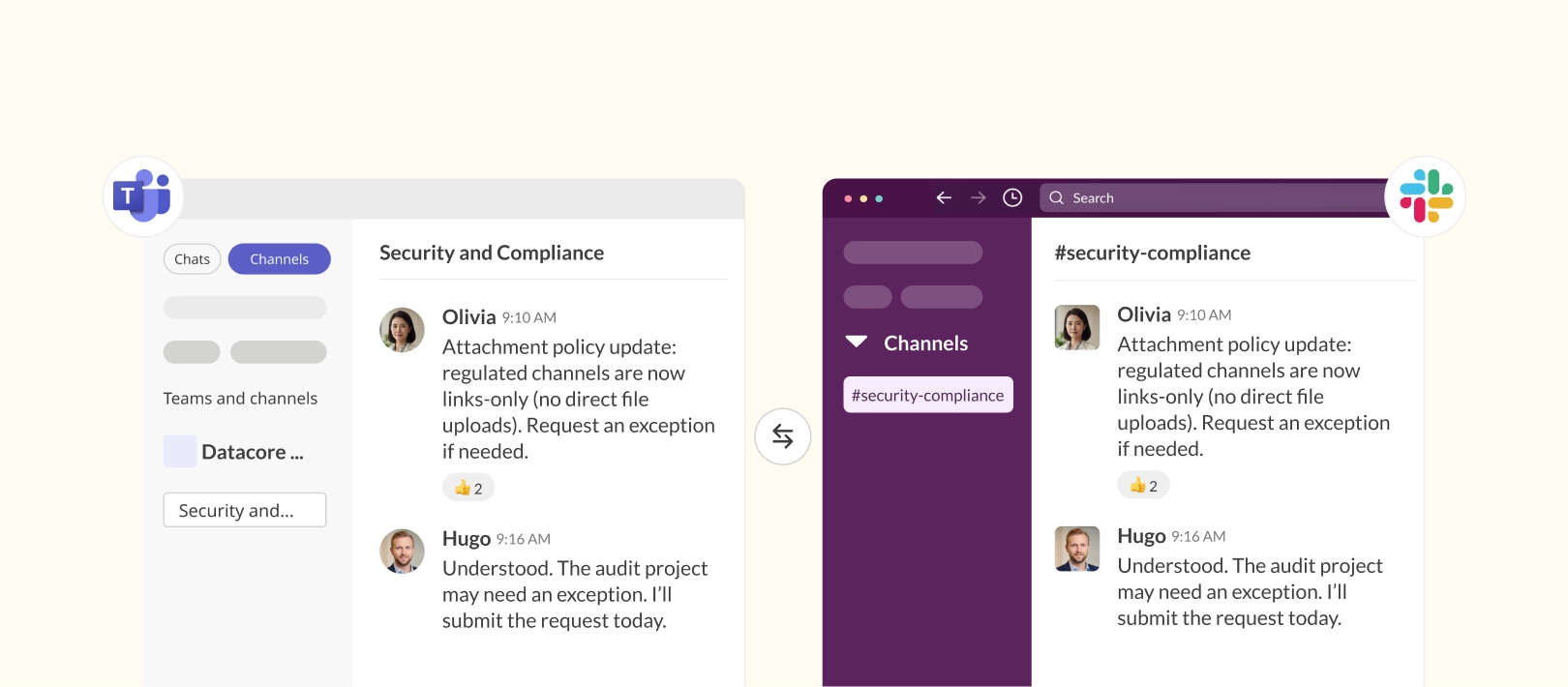
Conclude Connect is a secure integration layer between Slack and Microsoft Teams, allowing organizations to manage cross-platform communication without losing visibility.
Channel Messages and File Sharing Control for Admins
Conclude enables IT administrators to manage security permissions. Admins can see and manage all connections across different teams or with partners and clients in one place.
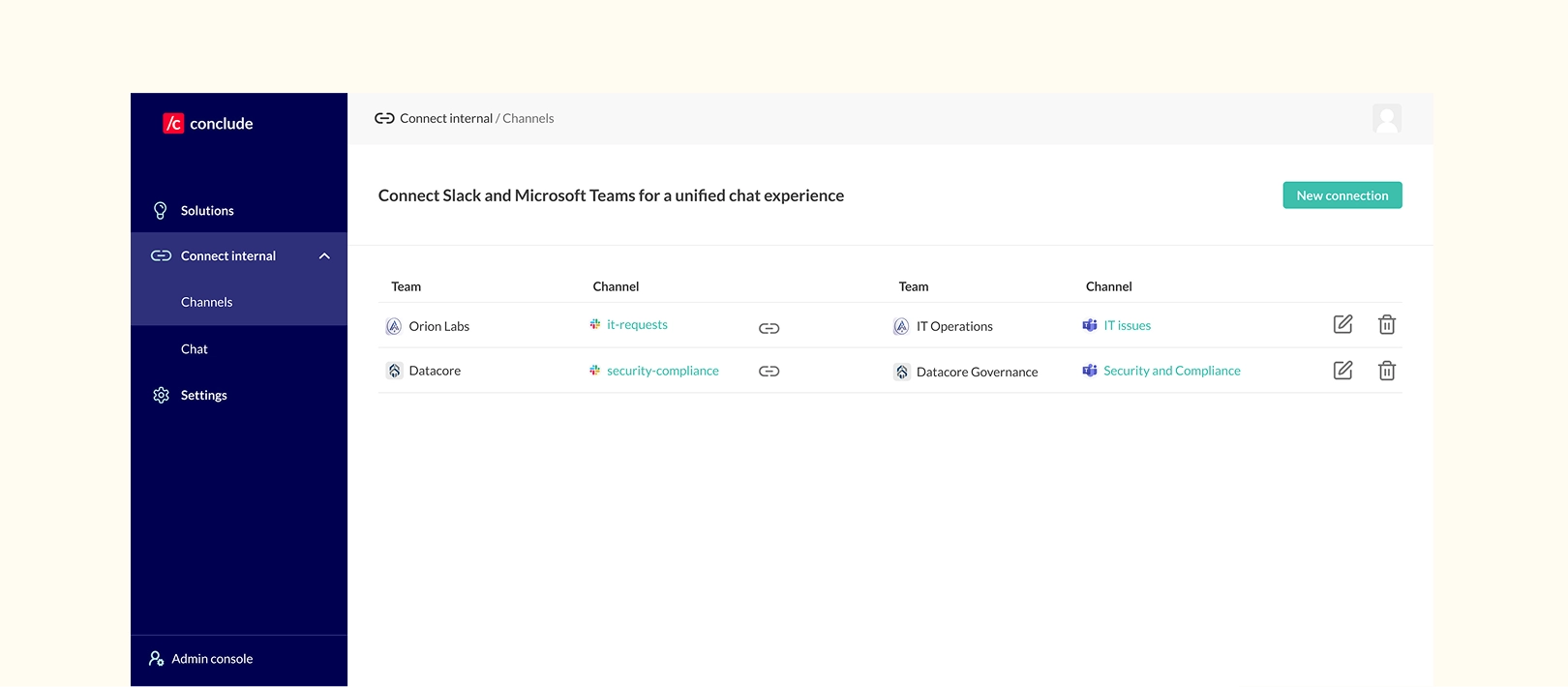
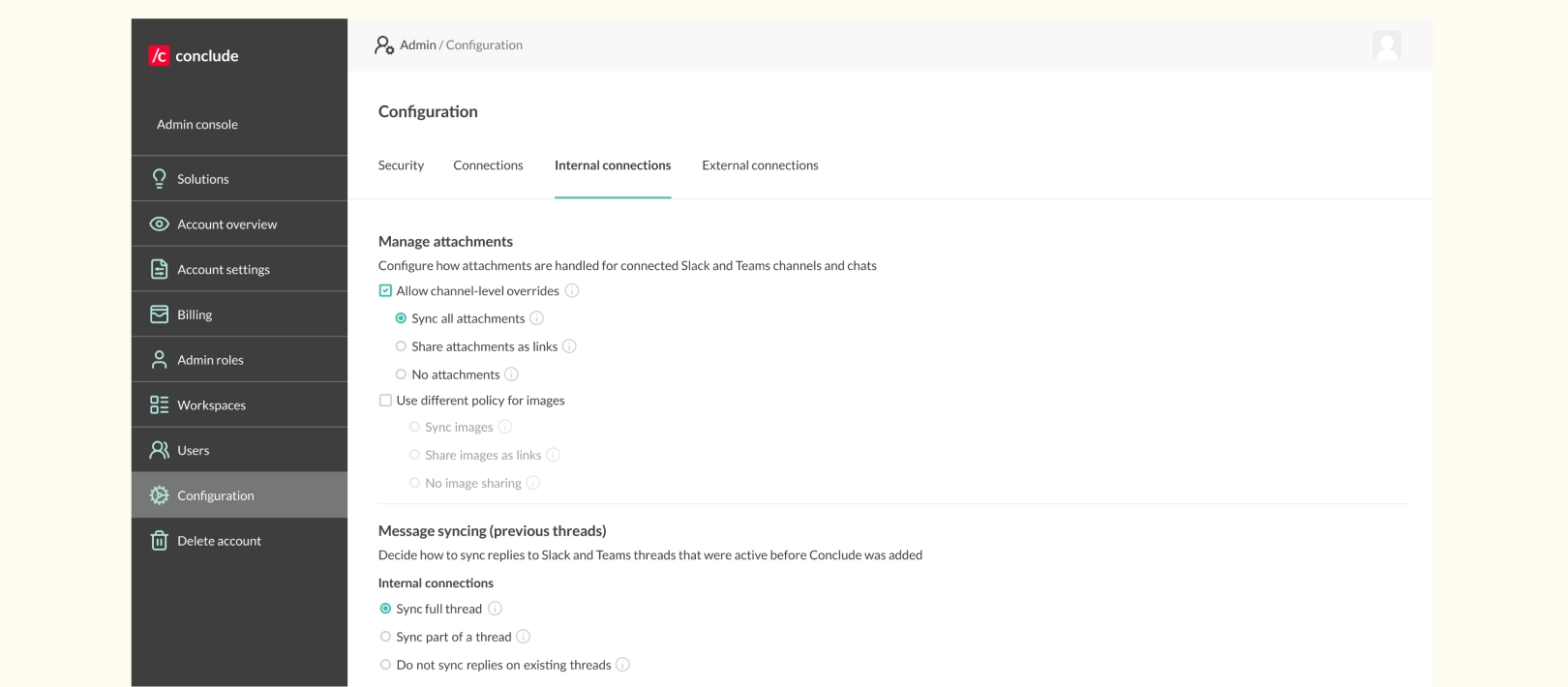
Admins can also set specific file and image sharing policies (available per connection) and define how new or existing message threads are synced across platforms. Automatic sign-out features can also be configured for tighter control.
Privacy-First Collaboration Software
Conclude Connect does not store messages or files and only processes the metadata needed to sync messages and activity across platforms. This means you don’t have to worry about securing a third location for your data. Learn more about Conclude’s security policy here.
- Certifications: SOC2 Type II certified, HIPAA compliant, and GDPR compliant
- Encryption: TLS 1.2+ encryption for data in transit and AES-256 for data at rest
- Minimal Permissions: only the necessary scopes that are required to do the job

Slack–Teams Security Without Consolidation
The idea that you must force everyone onto one platform is now outdated. With 75% of businesses using multiple apps and companies coming under the regulatory spotlight, you can’t afford to ignore the gap between Slack and Microsoft Teams. Secure connections allow IT teams to maintain enterprise collaboration security controls without breaking workflows.
Ready to get started? Try Conclude free for 14 days.
Frequently Asked Questions
How do enterprises maintain audit trails across Slack and Teams?
Gartner research shows that fewer than 40% of enterprises can successfully audit cross-platform data, often relying on manual exports or disjointed logs. The most effective way to solve this is by using a secure chat connection layer that ensures every cross-platform message is captured in both Slack and Teams.
What is the difference between platform consolidation and secure cross-platform communication?
Consolidation is the “ideal” that rarely works in practice – forcing everyone onto one tool usually creates resistance and shadow IT. Secure cross-platform communication is the pragmatic alternative: it accepts that Slack and Teams coexist and focuses on connecting them securely. This allows IT to maintain security and compliance without managing resistance from teams that are unwilling to switch platforms.
Can you enforce the same compliance policies across multiple platforms?
Not directly – Slack and Microsoft Teams each enforce their own compliance policies within their own environment. With a connection in place, messages are copied across platforms, so Slack’s retention and deletion rules apply to the Slack copy, and Teams’ rules apply to the Teams copy. This gives compliance teams policy coverage on both sides, without needing to manually duplicate conversations.
What is shadow messaging, and why is it a compliance risk?
Shadow messaging is what happens when official tools get in the way of work. If employees can’t easily message a colleague on another platform, they often switch to WhatsApp or other tools to communicate. This is a critical risk because these chats are invisible to IT; you can’t audit, secure, or retain data that you don’t know exists.
How does secure cross-platform communication help reduce compliance violations?
It solves the root cause of shadow IT friction. When you give employees an approved, easy way to chat across platforms, they stop using unmonitored workarounds. This brings sensitive discussions back into your managed environment, where your security tools can see them and your compliance policies can protect them.